


Beyond the corporate ladder: Dejan Trpkovic on leadership, ambition, and building a successful international business.
Olivera Milos Todorovic of PRESTUP, a cutting-edge independent monthly, talks to Dejan Trpkovic, the founder of PRODIREKT, one of the leading management development firms in Southeast Europe, about his career, his views on his home country’s business landscape, the winds of change in local marketing and PR, and how he sees his country in the future.
ఎడిటర్ యొక్క గమనిక: This is a complete English translation of the original interview published in Serbian in November 2004. The opinions, projects, and descriptions of Serbia’s business environment reflect that period.
After graduating in economics in Belgrade, Dejan Trpković completed postgraduate studies in business management at the University of Colorado in Denver. By the age of 31, he was a regional director for Hasbro, based in Vienna, overseeing the company’s operations in Poland and Hungary as well as 17 distributors across Central and Eastern Europe. Later, as World-Link’s vice president for Western Europe, he managed the American telecommunications company’s business from London.
He also founded Prodide, the agency that created the visual identity for Serbia’s Office for European Integration and helped develop and implement the country’s communications strategy for accession to the European Union.
“My career is important, but what matters much more to me now is quality of life in the human sense. It is the little things that make life worthwhile.”
Returning home after an international career
PRESTUP: Your success would be impressive by any standard, not just for someone from Serbia. People who spend years abroad often idealize their home country. Were you really sure you knew what you were coming back to?
Dejan Trpković: The reverse is equally true. Many people from Serbia idealize life in the West. Although I believe the ideal place to live is deeply personal, our roots and the place where we spent our childhood still play the most important role.
At the same time, living and working in different countries teaches you that ways of life, social norms, and habits associated with a particular country or culture are not necessarily “better” or “worse.” They are simply different. After more than two years in another country, your own habits and some of your convictions gradually begin to change, even those you once thought were firmly fixed. Only when you really get to know different cultures and customs do you become more objective in your judgments and less inclined to see things in absolute terms.
The fact that I had achieved a great deal professionally at a relatively young age played a significant part in my decision to return four years ago. I would rather not fall back on the familiar line that I returned to Serbia to help my country. There is truth in that, of course, but much more important to me was the personal decision to continue living in surroundings that felt like my own.
A career matters, but these days I care far more about quality of life in the human sense. It is the little things that make life worthwhile.

Building companies in a changing market
PRESTUP: You have been the driving force behind several companies, each of which has built a strong reputation in the local market. Why did you invest in PRODIREKT, a consulting firm specializing in management recruitment, and in Prodide, a marketing and public relations agency?
Dejan Trpković: Since my decision to return to Belgrade was entirely personal, once I had moved back I needed to decide where to take my professional career next. I had several attractive corporate opportunities, but the desire to test myself as an investor and to build companies shaped by my own experience, knowledge, and ideas ultimately won out.
It was the most difficult option, particularly because my experience in countries undergoing economic transition told me that the initial euphoria following Serbia’s political changes in October 2000 would fade quickly.
In Western business circles, professionals are particularly valued when they have succeeded in three distinct roles: senior leadership in a corporation, high-level consulting, and founding or owning a business. I had yet to prove myself as an entrepreneur. Doing so would complete that part of my career and, in a sense, validate what I had learned.
The challenge was to anticipate how the market would develop and offer the services that would be most needed once genuine competition took hold. In a competitive economy, both international corporations and fast-growing local businesses rely heavily on specialist management recruitment firms. The same goes for marketing and PR agencies.
Here, there is still a reluctance to use outside professional services. Many companies assume that having their own HR or PR department removes any need for external consultants. That has not happened in any developed market. As our market matures, demand will grow for the expertise, reputation, and professional networks that specialist consultants bring.
Why marketing and PR matter
PRESTUP: Prodide’s early days were marked by an award at the 23rd Salon of Architecture for the interior design concept of your offices. In a market that often seems more “flee” than “free,” what future do you see for Prodide as a marketing and PR agency?
Dejan Trpković: So far, Prodide has concentrated on marketing and public relations strategies, corporate communications, and visual identity. Business leaders are increasingly realizing that they cannot survive without investing in marketing.
Four years ago, when Prodide was getting started, some banks and well-known companies thought any website would do. They would simply ask “someone they knew” to put one together for €1,000. Unfortunately, many of those companies are now paying considerable sums to redesign their websites.
What matters is that the market is learning. More businesspeople understand the value of professional, effective communication. A website, for example, should not be conceived primarily as a programmer’s project. Its direction should come from marketing and communications professionals.
Monopolies and closed markets restrict consumer choice, stifle creativity, and lead to poor products and services. For more than a decade, companies with monopoly privileges operated on a simple assumption: “Whatever we make or offer, people will buy.” Consumers had virtually no rights and no choice.
In such an overwhelmingly seller-driven market, marketing expertise was not seen as necessary. Managers were not even interested in whether they could do more or do better. As competition grows, the rules of the market change, and so do managers’ attitudes toward marketing and other specialist services.
Unfortunately, powerful business groups and individual business leaders still try to frighten people with the prospect of competition. Competition may be ruthless in the short term, but over time it invariably gives consumers more choice and better value.
A strong service sector is one of the hallmarks of a developed market. With even a basic degree of political stability, I believe further development of the domestic economy will bring greater demand for marketing and PR services.
Our responsibility is to stand on the client’s side: help develop the strategy, make sure it is carried out, coordinate the work of different contractors, and protect the client from inefficiencies along the way.
Globalization and competition
PRESTUP: How much damage is globalization doing to our market?
Dejan Trpković: Who provides a particular service is not nearly as important as having choice and healthy competition. Foreign competition brings advantages. International standards for products and services, and the presence of foreign companies in Serbia, raise the quality of what is available domestically and introduce greater professionalism into business practices.
Of course, certain strategic sectors and consumer protections deserve particular attention. But it is essential that the rules of privatization apply equally to everyone. We should not favor domestic investors over foreign ones simply because they are domestic. We should choose what serves us best.
That familiar claim that foreigners will come and take everything away from us does not stand up to scrutiny. For example, do we really think that domestic conglomerates or successful local business owners can remain competitive indefinitely while carrying a surplus workforce?
B2B Interactive and the future of business journalism
PRESTUP: You recently attracted foreign investors to another venture, B2B Interactive, a regional group that will combine online media businesses with television programs about business. Who are these programs intended for, and what will shape their editorial approach?
Dejan Trpković: The popularity and rapid growth of two regional online portals, Autoberza.info and Aktuelno, provided the foundation for B2B Interactive. Once we had established a leading position in online media and developed close relationships with some of the best journalists in Serbia and abroad, the next step was to create a contemporary business television program with high production standards. Aktuelno TV forms part of an integrated media offering for Southeast Europe.
At a recent meeting with several respected journalists, I was struck by how narrowly they defined business journalism. For them, it largely meant reporting on macroeconomic policy, privatization, and the stock market.
There is a need for high-quality business information that goes much further. That includes analysis of business strategies and competitors, trends in technology and economics, and developments in neighboring countries that our own businesspeople could learn from or use to their advantage.
These insights can help us anticipate changes in society that countries such as Slovenia, Hungary, and Croatia have already experienced. We do not have enough of this kind of information or analysis.
We will soon begin specialist training for journalists, probably in cooperation with the Stiglitz Institute in the United States, to improve how they research, analyze, and report on business strategy, marketing, PR, design, and global technology trends.
Although some public and private broadcasters in the region are producing programs focused on business, most of them are primarily local in scope. A proper understanding of editorial independence, together with access to relevant specialist business information, is essential not only for a more efficient market but also for bringing our media closer to Western professional standards.
Aktuelno TV will help businesspeople understand and anticipate international market developments and make better day-to-day decisions.
What small businesses really need
PRESTUP: What is the greatest obstacle to the development of our economy and market?
Dejan Trpković: The lack of meaningful support for small and medium-sized businesses. It should be clear to everyone that rising unemployment can only be brought down by supporting the growth of these companies. The entrepreneurial and creative drive of individuals is essential to making the entire economy more competitive.
Successive governments have all declared their support for small and medium-sized businesses. The reality, however, has been discouraging. Existing regulations, taxes and government charges, limited access to bank loans, and the administrative burden of setting up a company have made life harder for entrepreneurs, not easier.
Reducing corporate income tax, for example, is a positive move, but it is not the most pressing issue for new businesses, which often do not become profitable until their third or fourth year.
I believe that even a substantial reduction in today’s high borrowing rates would have only a limited effect on the creation or growth of new firms. Access to credit is the much bigger problem. Banks require so much collateral that the whole process becomes a business paradox.
In Western markets, entrepreneurs may be able to obtain funding on the strength of a founder’s credibility, professional capabilities, track record, and, of course, the business plan they present.
Professional standards in marketing and public relations
PRESTUP: How would you describe the professional values and standards in marketing and PR today?
Dejan Trpković: I do not think a well-established set of professional values exists yet. It is still taking shape. A mature professional culture requires a strong connection between education and real business practice.
Most young people leave university completely unprepared for work in the business world. Many want to enter PR because it is fashionable, without really understanding how demanding the profession is or how much responsibility it carries. True public relations professionals are part of the business elite.
Another essential ingredient in the development of any profession is strong, independent professional associations. In that respect, the Serbian market is still evolving. Associations appear and disappear because they are biased, lack transparency, have no clear membership criteria, and, worst of all, apply their rules selectively.
Awards and festivals also play an important part in establishing professional standards. It sometimes seems to me that, in this area, we have managed to get ahead of the West, although not necessarily in a good way. Developed economies first had credible competitions, which later attracted countless imitators. Here, it seems the process may be reversed. We already have an entire industry devoted to handing out awards.
చివరి ప్రశ్న
PRESTUP: What do you value most in young, talented businesspeople?
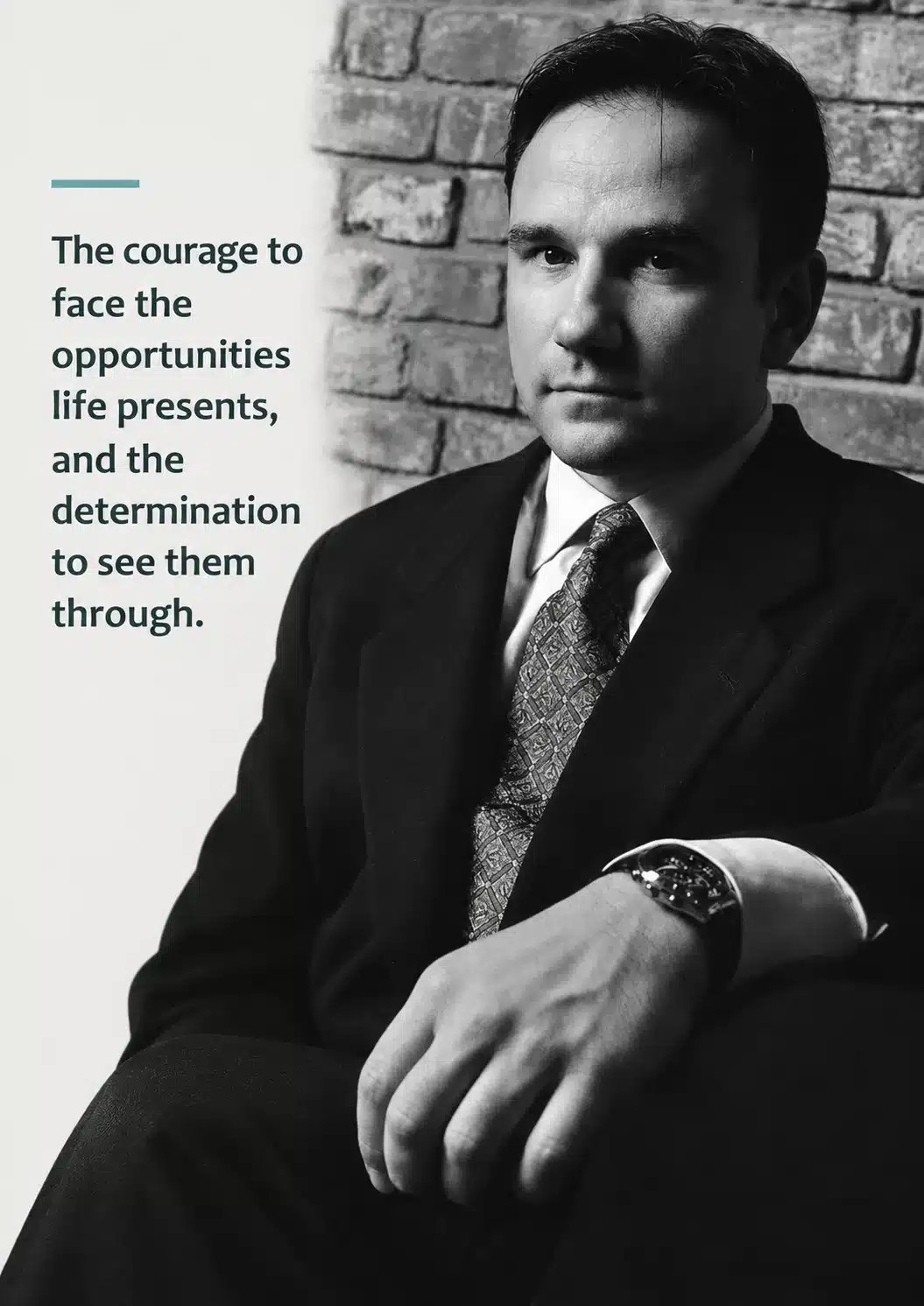
Dejan Trpković: The courage to face the opportunities life presents, and the determination to see them through.
Original publication: PRESTUP, Issue 18, November 2004, pp. 53–55. Interview: Olivera Miloš Todorović. Photography: Andrej Isaković. Translated from the original Serbian for PRODIREKT.
సెర్బియన్ భాషలో పూర్తి కథనాన్ని చదవండి: PRIVLAČNOST USPEHA, Olivera Miloš Todorovic, Prestup
PRODIREKT ప్రపంచ స్థాయి అంతర్జాతీయ అధ్యాపకులను నియమిస్తుంది మరియు అత్యాధునిక విద్యా సలహా మరియు వృత్తిపరమైన అభ్యాస అవకాశాలను అందిస్తుంది. PRODIREKTకెరీర్ మరియు టాలెంట్ మేనేజ్మెంట్ కోసం దాని వినూత్న పరిష్కారాలు వ్యూహం మరియు విద్య మధ్య వారధిని అందిస్తాయి, అదే సమయంలో దాని వ్యాపార సమూహం, Verbalists Education & Language Networkఅంతర్జాతీయ కమ్యూనికేషన్లో వ్యక్తిగత మరియు కార్పొరేట్ క్లయింట్లు తమ లక్ష్యాలను సాధించడంలో సహాయపడుతుంది.
నుండి మరింత కనుగొనండి PRODIREKT
మీ ఇమెయిల్కి పంపబడే తాజా పోస్ట్లను పొందడానికి సభ్యత్వాన్ని పొందండి.